A threshold that fits your service
Your service sets its own eligibility threshold and applies it to verified age evidence.
Check age eligibility. Keep onboarding simple.
Offer a dedicated age-check flow: the applicant submits a supported identity document and a live selfie, and VeriqoCheck validates the document evidence and matches the selfie to its portrait. Your business receives age in completed years, verification status and the assessment date through the dedicated result. Apply your own minimum age, such as 18 or 21, without receiving the document image, selfie image or date of birth in that result.
Check age with a supported identity document and matching selfie, with required live presence. Receive an age result without document images, selfie images or date of birth.
Your service sets its own eligibility threshold and applies it to verified age evidence.
The applicant submits a supported document and a live selfie. Face matching connects the selfie to the document portrait, with liveness required.
Receive age in completed years, verification status and the assessment date. The dedicated result excludes date of birth, document images and selfie images.
The result identifies incomplete capture and inconclusive evidence.
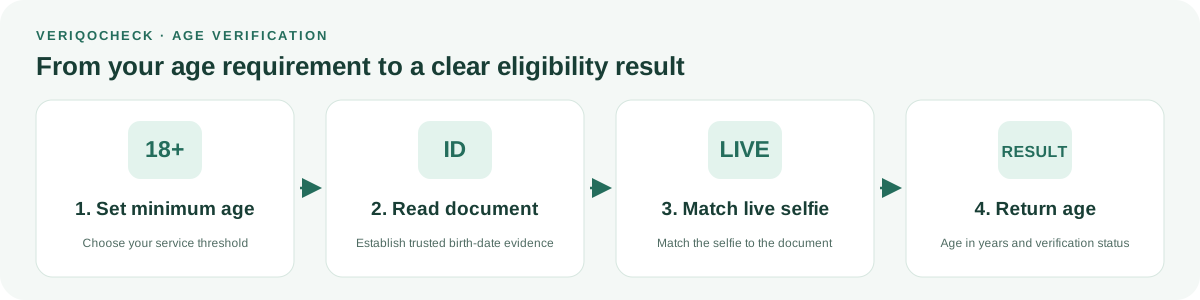
Request age verification and keep the eligibility threshold in your service.
Validate the supported document evidence, check live presence and match the selfie to the document portrait.
Read the age, verification status and assessment date, then apply your own over/under rule to a verified result.
Standalone Age Verification has its own endpoints and does not require NFC. Combining it with Digital Identity adds age extraction to the NFC document-and-presenter journey, using birth-date evidence from authenticated chip data.
VERIFIED indicates that the evidence and presenter checks passed. INCONCLUSIVE means the completed evidence could not establish age reliably. INCOMPLETE means checks are still outstanding.
The result uses a persisted UTC assessment date. It describes the check on that date and does not silently change on a later birthday. The full-year calculation treats 29 February birthdays as reaching their anniversary on 1 March in non-leap years; confirm suitability for your jurisdiction.
Standalone verification needs trusted document validation, not OCR alone. Capture support must be confirmed before launch; the current native iOS journey still needs its liveness integration. Backend endpoints can be used with a supported capture client.
OCR alone does not establish document authenticity. Standalone verification needs trusted document validation; the Digital Identity combination uses authenticated chip evidence. Facial age estimates are not used. Confirm capture readiness and the applicable birthday policy before rollout.
Africa first means starting with the markets, documents and devices your customers use. Coverage and capture readiness are confirmed for your deployment; no universal document support or guaranteed compliance is implied.
The dedicated age result returns age in completed years, verification status and the assessment date. It excludes document images, selfie images and date of birth.
The current API returns age rather than a threshold-only result. Your integration applies its own minimum age to a VERIFIED result and can show only the over/under outcome in your service.
Yes. Your service chooses the threshold and evaluates it against the verified age.
Yes. Enable ageVerification in the Digital Identity configuration or request DIGITAL_IDENTITY and AGE_VERIFICATION together in an applicant application.
No. Age verification uses trusted document birth-date evidence and the required presenter checks, not a facial age estimate.
No. An unreadable document requires further evidence before you can assess eligibility.
Share your markets, minimum age and onboarding flow. Let’s confirm the supported verification journey.
Get started with VeriqoCheck